James Webb finds water clouds that thicken and thin on WISE 0855, the coldest brown dwarf known
Eleven hours of Webb data show patchy water clouds and rising carbon monoxide on a Jupiter-sized object 7.5 light-years away, colder than a Murree winter night.
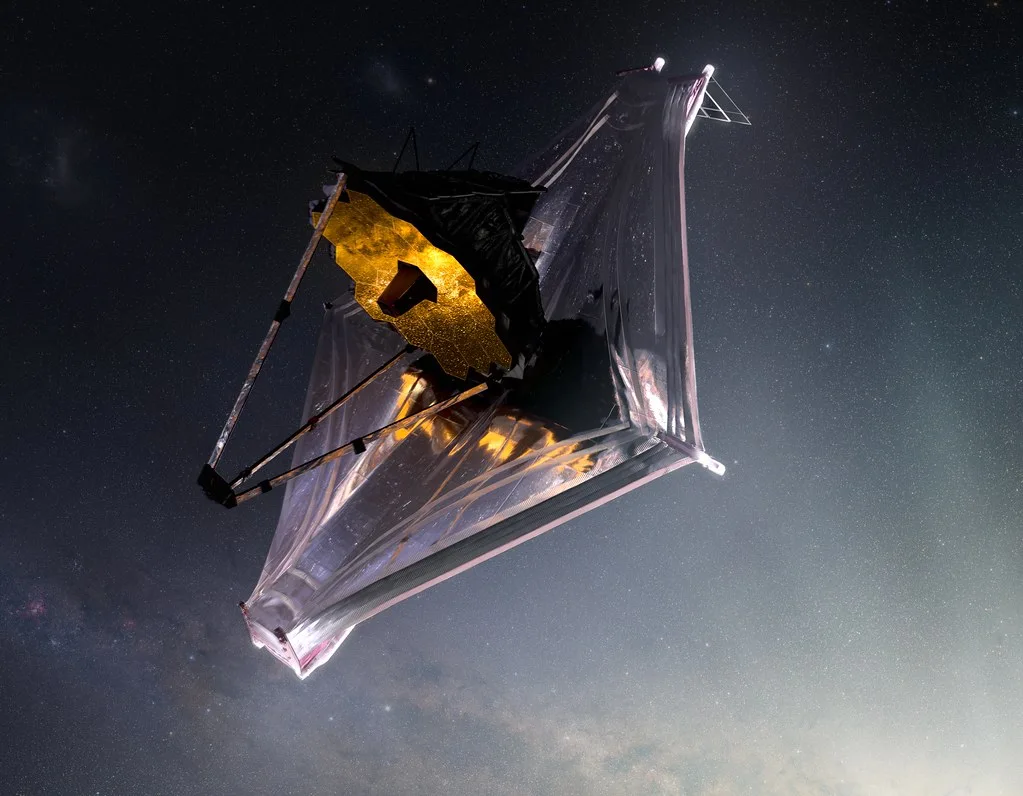
The James Webb Space Telescope has caught water clouds changing over a few hours on WISE 0855, the coldest brown dwarf ever found, a team led by Brittany Miles of the University of Arizona's Steward Observatory reports in a study posted on arXiv and accepted by The Astrophysical Journal. ARY News reported the findings on Saturday.
The object
| Fact | WISE 0855 |
|---|---|
| What it is | a brown dwarf: too big to be a planet, too small to burn like a star |
| Distance | about 7.5 light-years, one of the Sun's nearest neighbours |
| Temperature | about 265 kelvin, roughly minus 8°C |
| Size | about the size of Jupiter |
For comparison, minus 8°C is about what Murree or Skardu reach on a cold January night. No other brown dwarf yet found is this cold.
What Webb saw
The team pointed Webb's NIRSpec instrument at WISE 0855 for about 11 hours, taking a spectrum every 15 minutes at infrared wavelengths between 2.87 and 5.27 microns.
- Carbon monoxide was the signal that changed most, with swings of up to 10% at some wavelengths.
- Changes in carbon monoxide and phosphine rose and fell together.
- Comparing the data with atmosphere models pointed to patchy water clouds whose thickness changes as the object turns.
The authors read this as two layers of weather at once. High up, water clouds thicken and thin as WISE 0855 rotates. Deeper down, heat rising from the interior churns gases such as carbon monoxide and phosphine upwards. Older telescopes were not sensitive enough to separate the two signals.
Miles said the work shows the same physics that shapes gas giants like Jupiter also operates on these lonely objects drifting through space without a star.
Why it matters
WISE 0855 is the closest thing astronomers have to a cold, Jupiter-like world that they can study without a bright star drowning it out. What they learn about its clouds feeds straight into how they will read the light of giant planets around other stars, including those that future telescopes may examine for water.
What to know
- The paper is a preprint on arXiv; it has been accepted for publication but the journal version had not appeared by Sunday.
- Webb is a joint mission of NASA, the European Space Agency and the Canadian Space Agency.
Students preparing for physics papers can check their grade point average with our CGPA calculator.
Frequently asked questions
- What is WISE 0855?
- WISE 0855 is the coldest brown dwarf known, about 7.5 light-years from Earth with a temperature of about 265 kelvin (minus 8°C).
Sources
More in Science

Science
Margaret Hamilton, who wrote the Apollo moon landing software, dies at 90
MIT says the computing pioneer died on 30 September. Her code kept Apollo 11 on track minutes before Eagle touched down in 1969.
1d ago

Science
Pakistan's first astronaut: China to pick Zeeshan Ali or Khurram Daud in October
One of two Pakistani pilots training in Beijing will spend a week on China's Tiangong station running four experiments from Pakistani universities. The choice is due mid-to-late October.
28 Sept 2026
Science
WHO calls this El Nino a public health threat: cholera, dengue and a late monsoon
The WMO says it is the strongest El Nino in 40 years of records, running into 2027. The WHO names cholera, malaria, dengue and chikungunya, and delayed monsoons in parts of Asia.
22 Sept 2026
Reader comments 0
No comments yet. Say something useful.